Hollywood as propaganda and cultural power
The SympathizerHollywood as propaganda and cultural power is the novel’s account of how entertainment can shape political understanding: by deciding who speaks, whose history matters, and which images audiences carry away. In the making of The Hamlet, the narrator tries to improve the representation of Vietnamese people from inside a Hollywood production, only to discover that access to the set does not mean control over the story. The film can grant its Vietnamese characters a few lines and still make their suffering serve an American narrative of rescue and destruction.
Representation and the American story
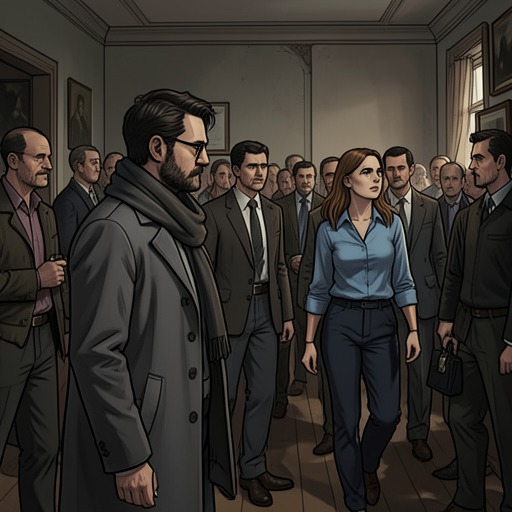
The narrator’s first serious encounter with the problem comes when he reads the screenplay and finds that a movie about his country gives none of his countrymen an intelligible word. His anger is sharpened by his meeting with Auteur, whose earlier films have made him one of Hollywood’s most powerful writers and directors. The narrator arrives as both a former movie enthusiast and a reader prepared to offer detailed criticism; he leaves the confrontation struck by Auteur’s dismissal of whether anyone cares about Vietnamese distinctions or perspectives. His silence in the office becomes part of the argument: the person who knows the people and place being represented can be rendered powerless before the person who owns the screenplay.
The narrator describes Hollywood as more than a source of entertainment. Its machinery carries American ideas and values across borders, making the audience receptive to the American story even when the film appears to be only a war adventure. In his account, Hollywood can appropriate a country without visiting it: imagination supplies the setting, while real people and historical experience become material for a story shaped elsewhere. The resulting power is not just the power to invent images, but to make those images circulate as the version of history that audiences recognize.
That imbalance is especially stark in the film’s treatment of the dead and of people who cannot speak for themselves. Auteur presents cinematic art as something that can outlast the war and, in his grandest claim, become the war in the public imagination. The narrator recognizes a partial truth in art’s durability but rejects the implication that a film’s survival makes it more important than the millions who died. If the dead cannot represent themselves, the question becomes who will do so, and under whose authority. Hollywood’s answer, as the narrator sees it, is that the people controlling the image will speak for them.
A consultant inside the machinery
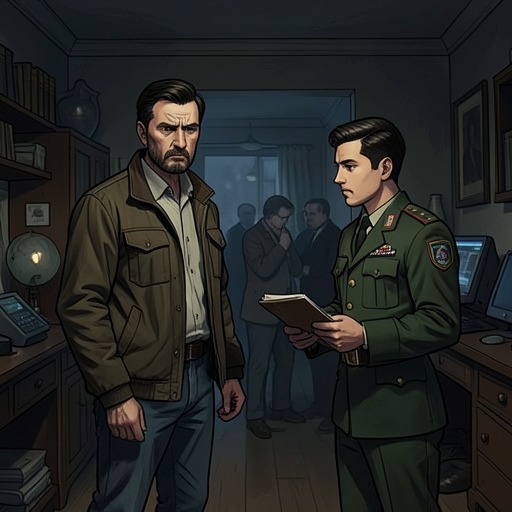
After Auteur has had time to reconsider the narrator’s notes, Violet offers him work as a consultant on Vietnamese matters. The production has researched history, costumes, weapons, and customs in books, but wants his human knowledge and asks him to work with refugees from Vietnam who will appear as extras in the Philippines. The narrator accepts partly because the job offers paid work and a respite from his American refuge, and partly because he hopes to make the portrayal less false. He goes to the production not simply as an adviser but, increasingly, as someone trying to intervene in a propaganda project from within.
His notes do produce a visible change. The script gains three Vietnamese characters with speaking parts: Binh, Mai, and Mai’s little brother. Yet their new visibility does not grant them equal narrative power. Binh becomes a translator and ally of the Americans, then dies at the hands of King Cong. Mai falls in love with Jay Bellamy, is kidnapped and raped by King Cong, and her assault becomes a justification for the Green Berets to annihilate King Cong’s forces. The boy, Danny Boy, is carried away from his devastated homeland toward adoption by Jay Bellamy’s family in St. Louis. The additions make Vietnamese characters more legible, but keep their fates arranged around American heroism, vengeance, and rescue.
The film’s production makes that hierarchy tangible in the distribution of work and wages. The narrator coordinates the extras’ wardrobe, meals, weekly pay, and movement between scenes; most receive a dollar a day. Many are refugees, and some are veterans of the Army of the Republic of Vietnam. Extras are readily found for civilian and South Vietnamese soldier roles, but few want to play members of the National Liberation Front, despite the shared language of freedom that complicates the categories. Some also object to portraying the torture of Binh or the rape of Mai. Violet agrees to double the wages for those taking the Viet Cong roles, and the increased pay helps overcome their reluctance. The production’s political simplifications thus have a material counterpart: Vietnamese performers are hired to embody opposing Vietnamese roles, while the people directing the film decide what those roles mean.
The limits of intervention
The narrator’s conflict with Auteur intensifies over Mai’s rape. He questions whether the scene is necessary, but Auteur defends it as a way to shock an audience and accuses the narrator of being a sellout. The exchange exposes the narrowness of the consultant’s authority. He can argue for changes, but Auteur retains the power to decide what suffering the audience must see and how that suffering will function in the plot. A sexual assault becomes not an experience explored on its own terms but a device that authorizes the final violence against King Cong.
The narrator also understands his assignment through his correspondence with Man. In a letter, he worries that his work makes him a collaborator; Man’s reply directs him to Mao’s arguments about art and literature. Art, in that account, can serve revolution by reaching people through entertainment, but it can also be used for domination. The lesson is not that the film becomes politically harmless if the narrator improves it. Rather, his work matters because representation is a political arena, and because refusing to participate would leave the production’s assumptions wholly uncontested. The narrator therefore thinks of himself as an infiltrator, though the metaphor cannot resolve whether his presence changes the work or helps it appear more authentic.
Spectacle, labor, and historical memory
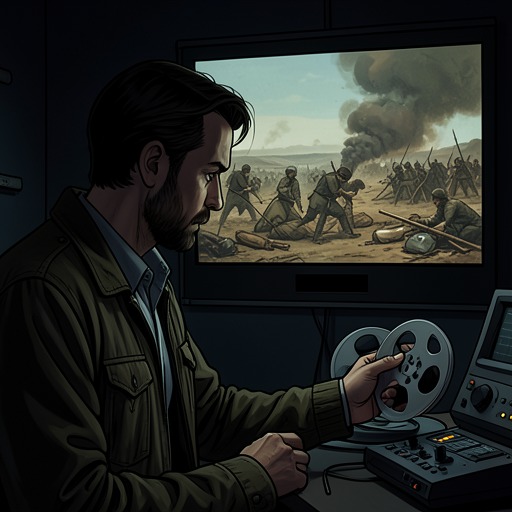
As production advances toward the climax, the scale of cinematic destruction overwhelms the modest gains in representation. Several weeks of work produce roughly fifteen minutes of helicopters, rocket fire, gun battles, and the destruction of elaborate sets. The shoot consumes smoke, explosives, and blank rounds; the Philippine air force supplies low-flying F-5s for a napalm strike. To meet a script calling for the deaths of hundreds of Viet Cong and Laotians, about a hundred extras repeatedly perform their deaths, some appearing to die four or five times. The film’s manufactured casualties are meticulously staged, while the performers’ real work remains largely behind the image.
The narrator’s sharpest recognition is that he has helped make the spectacle more convincing without changing its destination. His contribution has added Vietnamese speech, corrected details of dialect and clothing, and made the background people more authentic just before the story kills them. He likens his task to making the stitching correct in an outfit designed and consumed by wealthy white people. Those who control the means of production also control the means of representation; the people appearing on screen can hope for little more than a brief word before anonymous deaths. What began as an attempt to redirect the film has, in part, smoothed its path by supplying the appearance of cultural accuracy.
The narrator consequently sees The Hamlet as both a sequel to the war that has already happened and a prequel to future American wars. Its artificial destruction can rehearse and normalize the destruction of people outside the American story, while turning military power into thrilling entertainment. At the same time, the film’s final image and its polished craft make it difficult for him to dismiss as merely inept propaganda. Watching Danny Boy rise in a Huey helicopter above the ravaged homeland, the narrator acknowledges Auteur’s technical talent and the work of the extras. He feels shame for having contributed to the film, but pride in the performers’ grace within roles that reduce them to types. That divided response gives the concept its force: the production can be beautiful and horrifying at once, and a small improvement in representation can neither undo its governing perspective nor make participation uncomplicated.